
![[personal profile]](https://www.dreamwidth.org/img/silk/identity/user.png) amruniel
amruniel
Total Words Written: 195.325
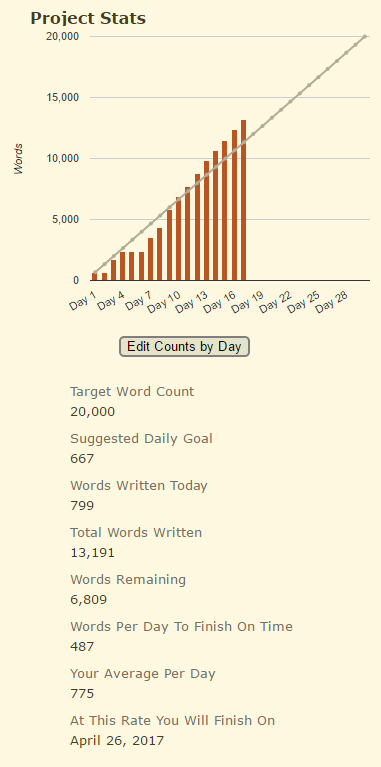
Whew. Finally.
Against all odds I finally finished up the part I was working on these past days, which means tomorrow I might actually make headway into the scene, possibly even getting it finished up (that is IF I remember what I wanted to include there ... I should have made a few notes after all *sigh*).
And once I get the scene done, dear Vig will finally re-appear in the story. I miss having the man around ... even if it's just half a scene or so without him.
(But as we all know - no Vig means no innuendo, no flirting, no touches, no nothing *sigh*)
On another note - can anyone of you dears give me a crash-course on English punctuation? Particularly on punctuation in connection with direct speech? It has come to my attention that I'm creatively doing *something*, but I'm guessing how I'm doing it is not how it should be done :D (And funnily enough, I'm NOT using German punctuation either... it's a weird "might be right but most likely isn't" mix-up invented by yours truly.)
Anyway - since I'll have to go back and edit 195.000 words anyway in terms of punctuation, I figured I might ask *now* and get it right at least in the latter part of my story :D
Anybody willing to explain?

![[community profile]](https://www.dreamwidth.org/img/silk/identity/community.png)
no subject
Date: 2017-04-18 05:06 am (UTC)"There is always some sort of punctuation, usually a comma, before the closing quotation marks," said Legolas. "If, as is usually the case, the speech is a normal declarative sentence, then that comma is there in place of the period (full stop), whenever there is a 'said so-and-so' phrase to follow. When there is no such phrase, the period (full stop) acts as the end of the direct speech itself and also the sentence that contains it."
He added, "Likewise, if you have an introductory phrase before your direct speech, set it off with a comma before the opening quotation marks."
"What if the speech has a different ending of a sentence, such as a question or exclamation mark?" asked Aragorn.
Legolas replied, "It stands in place of the comma, of course." His friend nodded. "However, despite temptation, you should never capitalize the phrase that follows unless it is truly a new sentence," continued the Elf.
Aragorn observed, "I see you capitalize the beginning of the sentence of the direct speech, even if there is an introductory phrase. But I don't know what to do if...." He trailed off, distracted, then continued, "... if the beginning of my direct speech isn't also the beginning of a sentence."
"Such nit-picking!" laughed the Elf. "Treat sentence fragments in direct speech just as you would in normal narrative, as to both punctuation and capitalization. My suggestion of the use of ellipses, above, is only useful for the rare case where you actually end a narrative sentence in the middle of a broken reported sentence."
"Sometimes I see single quotation marks. What's with that?"
"In North American usage, which I am describing to you here, double quotation marks surround direct speech, while single quotation marks are used for, as they say, 'embedded quotations'."
"You mean the British do it differently?" sighed Aragorn.
"Sometimes." The Elf was smiling. "You will quite often see the reverse of that usage (single quotation marks around reported speech, with double quotation marks for embedded quotations) in British publications and, especially, in academic writing. However, the North American standard seems to be prevailing, so I would advise using that."
Here, surreysmum interrupted her voluble characters to summarize. :) So, the mistakes I most often see in fan writing are:
"Put that hobbit down!" Shouted Sam at the spider.
"Are you my dinner, Frodo?" Asked the spider.
"I am no-one's dinner." Said Frodo bravely.
DO NOT capitalize a modifying phrase after direct speech, regardless of the speech's closing punctuation. However, you should capitalize after direct speech if what follows is actually the beginning of a new sentence.
"I am no-one's dinner." His voice quavered as he said it. (This is correct)
Other mistakes:
"I am no-one's dinner", said Frodo.
(Punctuation goes *inside* the closing quotation marks, always).
"Are you my dinner?", asked the spider.
Sam said, "You are a fool.".
Frodo shouted, "Run!".
(Do not double the punctuation)
Frodo shouted "Run!"
In a very short sentence, such as the one above, the omission of the comma after an introductory phrase (Frodo shouted) is becoming much more acceptable in modern usage; it's cleaner. However, you're generally on firmer grammatical ground if you insert a comma before your opening quotation marks, especially if the speech that follows is of any length.
I hope that's not TMI. As I said, I'm happy to address a few actual instances of your own writing if you'd like that. My e-mail is surreysmum AT gmail DOT com.
My qualifications, such as they are, are a couple of degrees in English literature, a voracious reading habit, and a childhood that was split between Britain and North America, making me sensitive to questions of language usage. :)
no subject
Date: 2017-04-18 12:42 pm (UTC)Thirteen years ago (and almost thirty years out of school) I had to relearn several of the things you mention above. I think I went back in my LJ and corrected most of my early errors, but this move to Dreamwidth is probably a good opportunity for me to double-check!
no subject
Date: 2017-04-18 09:42 pm (UTC)looks like we'll be both checking our respective fic(s) for punctuation in the near future with that great guide!
(And hopefully surreysmum's guide will make your beta work a lot easier as well :D)
no subject
Date: 2017-04-19 01:49 am (UTC)no subject
Date: 2017-04-19 10:01 pm (UTC)What's interesting (and lovely) is that I've noticed several friends re-appear - almost as though the real threat of losing LJ has made people realise that there's something there worth hanging on to!
no subject
Date: 2017-04-20 01:36 am (UTC)And that just goes to show that, as your icon says, every seemingly bad situation has something good coming along as well.
(And now I'm stuck with Sam's "There's something good in this world Mister Frodo, and it's worth fighting for" running around in my head... ah I love that scene!)
no subject
Date: 2017-04-20 09:16 am (UTC)And then I was smiling like a Cheshire Cat when Orlando goes on and on about how amazing Viggo is!
no subject
Date: 2017-04-20 08:40 pm (UTC)Oh my God! You’re giving me the best ideas, sweetie! I HAVE to watch the cast commentaries again! I didn’t do it in ages gasps And yes, Orlando gushing about Viggo certainly is always worth it 😉
no subject
Date: 2017-04-18 09:21 pm (UTC)This is incredible! And so, so helpful! Thank you so much! *hugs*
(I might have to print the whole comment out in order to always be able to check back!)
Well, I think (at least most times) I got the capitalization right. That's something that buggs me immensely when reading, so I my "feeling" for the language or gut intuition should have kicked in there.
I did, however, completely missed the mark on the actual punctuation - I put the comma outside the quotation marks. (I *knew* that in English there was a comma where there is none in German, I just wasn't sure *where* exactly... and I obviously was too lazy to look it up while actually caught in the writing process itself.)
Great explanation on using " vs. '! And particularly of interest for me - the hint on what's the norm in academic writing (and in a combination of British usage and academic writing, in my case).
I have had to write a couple of more or less academic essays and papers, but so far I (think I) never had a situation where I used direct speech outside of quotations, and I just had to transfer them word for word and punctuation mark for punctuation mark there, obviously. But since there are quite a lot of papers waiting for me over the course of the next semesters/years, I'm sure this knowledge will come in handy there, too!
Thank you so much for your offer to check over "real life" instances is my writing, but I think I'll just have to go over it with a fine-toothed comb and straighten up all the direct speeches with your excellent guide! But if I come across something I'm not sure about I'd love to be able to check back with you then if the offer still stands in a couple of weeks or months :)
On another note- in my fic Orlando holds a degree in English lit as well. And while I feel remotely knowledgeable in what I'm writing about, I'm just a lowly student, with no degree to show for so far, so.... might I contact you if I need some advice in this quarter as well?
Again, thank you so, so, so much for your in-depth (and very funny!) explanation! I really appreciate it! *hugs*
no subject
Date: 2017-04-19 01:51 am (UTC)no subject
Date: 2017-04-19 08:59 pm (UTC)(And Legolas can lecture me on punctuation anytime! Actually... does he give lectures on syntax, morphology and/or phonetics as well? I suspect I'd have a lot more fun learning that stuff if he (and Aragorn) explained it..... *giggles*)